

You've probably stood in a showroom or scrolled a product page trying to figure out why one sauna costs three times another, and walked away with more questions than you came in with. The price gap is real, the jargon is dense, and the marketing rarely helps. Every brand seems to be selling something slightly different while calling it by the same name.
That confusion is understandable, because infrared saunas are genuinely not a single technology. They're a family of related but distinct systems, and most of the chaos in the market comes from treating them as if they were interchangeable.
The core distinction that separates every infrared sauna from every other kind of sauna is this: instead of heating the air around you, infrared saunas use emitted light energy to warm your body directly. The Mayo Clinic confirms that infrared saunas operate at lower temperatures than traditional saunas, and the reason comes down to that mechanism. When the heat goes into you rather than into the room, you don't need the same scorching air temperatures to produce a meaningful physiological response. A traditional sauna might run between 158°F and 194°F. An infrared sauna typically operates somewhere between 113°F and 160°F, with most users finding their sweet spot in the 120°F to 140°F range, according to research cited by the Mayo Clinic and Cleveland Clinic.
But even within that definition, the category splits in several directions. The infrared spectrum itself has three distinct wavelength bands: near, mid, and far. Some saunas use only one. Others, marketed as full-spectrum, combine all three. Each wavelength behaves differently and reaches different depths in the body. That distinction matters more than most buyers realize when they're comparing options.
Then there are the questions that don't fit neatly into a wavelength discussion. How does an infrared sauna compare to a traditional Finnish-style dry sauna? What about steam? Where does red light therapy fit in, and is it the same thing as infrared or something different? What does "low-EMF" actually mean on a spec sheet, and should it change your decision? What does the physical experience feel like when you walk into one?
What's ahead:you'll get a clear picture of what makes a sauna "infrared" at the technology level, a plain-English breakdown of the three wavelength types, direct comparisons between infrared and traditional dry saunas, infrared and steam, and an honest look at where infrared sits relative to related therapies like red light panels. You'll also get a grounded look at EMF ratings, what low-EMF labeling actually means in practice, and what the physical design and session experience actually look like. And because wellness claims in this category tend to run ahead of the evidence, you'll get a realistic read on where the research is strong and where it's still catching up.
By the end, you'll have a framework that lets you cut through the marketing, compare options on dimensions that actually matter, and make a decision that fits your situation.
Infrared Sauna Definition & Basics
The technology feels newer than it is. John Harvey Kellogg built what's now recognized as the precursor to the modern infrared sauna in 1891, an incandescent electric light bath that used radiant heat rather than hot air. The formal clinical era came later, when a 1965 Japanese patent introduced ceramic far-infrared emitters initially adopted by physicians before any consumer market existed. Full-spectrum models reached the American public by 1979. The wellness boom of the 1990s and 2000s turned a medical and research tool into a commercial product category, which is partly why so much confusion surrounds it today.
So what exactly qualifies as an infrared sauna? The definition has two parts. The physical structure is a cabin-style enclosure, typically wood-lined, where a person sits or reclines during a session. What makes it infrared, rather than just a small heated room, is that the primary heat source is infrared emitters. Those emitters produce light energy that your body absorbs directly.
Human skin absorbs infrared radiation efficiently because it naturally emits energy at a similar wavelength, around 9.4 microns, which is why the heat registers immediately on contact rather than requiring the room to reach a scalding temperature first.
Infrared sauna therapy, as a practice, is the deliberate use of that heat exposure for wellness purposes: recovery, relaxation, skin health, and other outcomes the research is exploring with varying degrees of confidence. The Mayo Clinic notes that studies show promise for infrared saunas in addressing certain long-lasting health problems, and some evidence points toward cardiovascular benefits. The Cleveland Clinic has identified skin health, including collagen production and pore cleansing, among the documented associations with regular use. Where specific claims start running ahead of the evidence, including assertions about treating cancer or producing dramatic weight-loss results, it's worth approaching those with caution, since the science hasn't established that kind of support.
A few distinctions matter before going further. Not every sauna is an infrared sauna. A traditional Finnish-style sauna heats the air, which in turn heats you. A steam room works through humid convection. Neither qualifies as infrared, regardless of what a product listing might imply. The reverse holds too: not every infrared device is a sauna. Red light panels, handheld infrared devices, and portable infrared wraps all use light energy, but none is a sauna in any meaningful sense. The word "sauna" implies an enclosure large enough to sit inside with a sustained heat session. Products that don't meet that standard are infrared devices, not infrared saunas, whatever the label says.

Within the infrared sauna category itself, the differences are real and consequential. The wavelength used, the type of emitter, and whether a unit covers a single band or the full spectrum all affect what the heat does and how deep it reaches. Those distinctions are worth understanding on their own terms before you start comparing price points or weighing brand claims.
Infrared Sauna Technology & Mechanism
When an infrared sauna's heating panels are powered, their molecules vibrate and release energy as infrared radiation. That radiation travels through the cabin and is absorbed directly by your skin rather than warming the surrounding air first. Your body converts that absorbed energy into heat internally, which is what produces the thermal response you feel.
The emitter panels convert electrical energy into infrared wavelengths and radiate them outward. The air in the cabin warms incidentally, but that's a secondary effect. The primary transfer is directly into tissue.
This explains why the perceived intensity of an infrared sauna often exceeds its reported air temperature. The cabin temperature in an infrared sauna can feel genuinely intense at temperatures that sound mild on paper. Direct tissue absorption drives the physiological response, not the ambient air temperature. The Cleveland Clinic confirms that infrared saunas raise core body temperature efficiently at lower air temperatures, and separately, the conventional wisdom holds that hot rock saunas rely on ambient heat to do that same work. Many manufacturers cap operating temperatures well below 140°F, and the Cleveland Clinic recommends not exceeding 160°F. Some models can reach 150°F to 160°F, but most users find a comfortable target well below that ceiling.
A conventional oven heats a roast by raising the air temperature around it until that heat conducts inward. A microwave excites molecules inside the food directly. Infrared heating operates on a logic closer to the second method: energy goes into the body rather than into the room.

One question that comes up frequently, especially from safety-conscious buyers, is whether infrared saunas emit UV radiation. They don't. Infrared radiation is non-ionizing electromagnetic energy that sits adjacent to visible red light on the spectrum but is invisible to the eye. UV radiation occupies a different part of the spectrum entirely, with shorter wavelengths that carry enough energy to damage DNA. Infrared carries no such risk. The Cleveland Clinic notes that infrared saunas lack the UV risks associated with skin damage. Side effects that do occur, including dehydration and heat exhaustion documented by Healthline, are associated with heat exposure and session length. Whether the radiation type itself plays any independent role is not something the current evidence clearly resolves, so treating heat management as the primary safety consideration is the practical takeaway.
Because the heating mechanism bypasses the ambient air, infrared saunas also warm up faster than traditional saunas. Rather than waiting for rocks or an air mass to reach operating temperature, the panels begin emitting immediately. Most units reach a usable temperature within about 10 to 15 minutes.
The underlying physics also follows Wien's Law of Displacement, which governs how heated objects emit infrared radiation across the spectrum. This is part of why human skin and infrared emitters interact efficiently: skin naturally emits energy at around 9.4 microns, a wavelength that overlaps closely with the output range of infrared sauna panels. The body isn't just passively receiving external heat; at a physical level, it's absorbing energy at wavelengths it's already tuned to receive.
Once direct tissue absorption is clear as the core mechanism, several design choices that looked like limitations start making sense as deliberate features. The relatively low ceiling temperatures aren't evidence of an underpowered product. The absence of UV output isn't a trade-off. Both follow directly from what infrared heating is and how it works.
What changes the experience meaningfully from one sauna to the next isn't the core mechanism, which is consistent across the category, but the specific wavelengths the emitters produce. Not all infrared panels operate at the same frequency, and those differences produce products that behave quite differently in practice.
Types of Infrared Saunas (Near, Far, Full-Spectrum)
The infrared spectrum is wide, and the sauna industry has carved it into three named bands. Understanding which band a product uses tells you more about its behavior than any marketing claim on the box.
Near infrared (NIR)sits at the shorter end of the infrared range, with wavelengths typically around 0.7 to 1.4 microns. That proximity to visible red light is directly physical: NIR emitters produce wavelengths that overlap with the visible red light spectrum, which is why a sauna using NIR panels often has a distinct reddish glow. The penetration depth is relatively shallow, reaching roughly 1 to 2 mm into tissue, making NIR primarily a surface-level technology. Some early research points toward cellular effects at this depth, including possible influence on mitochondrial function, though the evidence is still developing and more studies are needed before strong conclusions apply.

Far infrared (FIR)works at the opposite end of the range, with wavelengths extending out to around 1 mm. Those longer wavelengths reach considerably deeper into tissue.
The Cleveland Clinic cites far infrared rays penetrating 1.5 to 2 inches into body tissues, accessing muscles and joints rather than just the skin's surface.
That deeper reach is why FIR dominates the consumer sauna market. It produces the thermal response most people associate with sauna use, and it's the technology behind the majority of standalone cabin-style units you'll encounter when shopping.
Mid infrared (MIR)sits between the two, with penetration depth reaching soft tissue at roughly 2 to 4 cm. It's the least discussed of the three bands in product marketing, but it occupies meaningful territory in the spectrum between surface-level cellular effects and deep tissue thermal work.
Full-spectrum saunascombine emitter types to cover all three ranges simultaneously. Rather than optimizing for one depth of penetration, a full-spectrum unit delivers heat across multiple levels at once. These units typically operate in the 110 to 140°F range and use multiple heater configurations, often ceramic-carbon hybrid panels, to cover the full wavelength range. Full-spectrum models are generally more expensive than single-band units, and many sources consider them the better option for achieving a broad range of benefits precisely because they address multiple penetration depths in a single session. Whether that breadth matters in practice depends on your specific goals: someone focused exclusively on deep muscle recovery may find a well-designed FIR sauna does the job, while someone interested in the full range of wavelength-specific effects would have a clearer reason to consider full-spectrum.
Red light and infrared are often confused. NIR emitters produce visible red light as a natural consequence of their wavelength range, not as a separate feature. FIR emitters operate at wavelengths far outside the visible spectrum and produce no visible glow at all. Some manufacturers add dedicated red light therapy panels to their sauna cabins as an optional add-on. Those panels are separate components with separate controls, not a byproduct of the sauna's primary infrared output. Consumers should verify whether a specific model actually includes red light therapy if that matters to their goals, because NIR emitters and dedicated red light panels are two different things. NIR emitters in near-infrared saunas can emit wavelengths that overlap with red light therapy ranges, but they typically lack the precise targeting of dedicated LED red light therapy devices.
Reading a product spec sheet with this framework becomes straightforward. A listed wavelength in the 0.7 to 1.4 micron range is NIR. Wavelengths extending into the longer ranges indicate FIR. A unit advertising all three bands is full-spectrum. A visible red glow means NIR emitters. No visible light means FIR. Any red light panel called out as a separate feature is exactly that: a separate component worth confirming before purchase.
Infrared vs. Traditional Saunas

A professional kitchen and a backyard grill can both cook a steak to the same internal temperature, but the method, the time, the experience, and what each does well are completely different. No chef would call one universally superior.
Traditional Finnish-style saunas and dry saunas operate through convective heating: the stove, whether wood-fired or electric, raises the air temperature in the cabin to somewhere between 150°F and 195°F according to the Mayo Clinic, and that hot air transfers heat to your body through convection and surface conduction. Your skin absorbs that ambient heat, and your core temperature climbs from the outside in. Sessions are usually 10 to 20 minutes because the ambient intensity limits duration.
Infrared saunas skip the air-heating step entirely, as the Cleveland Clinic confirms. Direct tissue absorption does the work, which is why the cabin air stays cooler while your core body temperature, the actual physiological outcome both approaches are pursuing, still rises. The cooler air temperature isn't a workaround or a limitation. It's the expected result of a heating method that doesn't need to warm a room to warm a body.
That distinction produces real practical differences. Infrared sessions generally feel less intense, which makes them more accessible for heat-sensitive users or anyone who finds traditional sauna temperatures difficult to tolerate. The lower ambient heat also extends how long most people can comfortably stay in a session.
On installation, infrared units are generally simpler and less expensive to set up, with prices typically ranging from around $2,000 to $10,000 compared to $10,000 or more for traditional builds.
Running costs tend to run lower as well.
Where the comparison gets more complicated is on the research side, and this is the part worth paying careful attention to if you've been following Andrew Huberman's work or similar performance-focused sources. Huberman's protocols emphasize traditional saunas, and the foundational research on cardiovascular health and longevity markers primarily used high-temperature Finnish-style saunas. Heat shock proteins are proteins your cells produce in response to thermal stress to help repair and protect against cellular damage, and core body temperature elevation, the measurable rise in internal temperature that triggers these downstream effects, is the shared physiological target both sauna types aim to achieve. The Finnish study base for traditional saunas is deep. For infrared-specific protocols, the research is growing but thinner, and the Mayo Clinic notes that direct comparisons between the two types regarding health effects are scarce.
Practically, if you're applying a specific protocol built around traditional sauna research, you're extrapolating when you substitute an infrared session, even if the core temperature elevation is comparable. That's not a reason to dismiss infrared use, but it's an honest framing of where the evidence currently stands.
Neither type is categorically superior. The Cleveland Clinic identifies infrared saunas as suitable for individuals seeking lower-heat therapy. For those who want higher-intensity heat, or who are following protocols tied to traditional sauna research, a conventional Finnish-style or dry sauna is the more direct match. For home installation, longer session tolerance, and accessibility for heat-sensitive users, infrared has clear advantages. The right choice follows from your goals and your body's tolerance, not from the category with the better marketing.
Infrared vs. Steam Saunas

Steam rooms and infrared saunas share a wellness context and little else. A steam room, sometimes called a wet sauna, works through a fundamentally different mechanism: a steam generator boils water and floods the enclosure with saturated vapor, raising both heat and humidity simultaneously.
That humidity is the defining variable. In a dry environment, your body cools itself through evaporation: sweat reaches the skin surface, evaporates into the air, and carries heat away. In a steam room, the air is already saturated with moisture, so that evaporative process is significantly impaired. Your sweat can't evaporate efficiently, which means your body's primary cooling mechanism is working against resistance the entire time. The result is that a steam room often feels more intense than its actual air temperature would suggest, because the heat your body generates has nowhere productive to go.
This is evaporative cooling impairment in practice, and it explains one of the most common points of consumer confusion: why steam rooms feel hotter than infrared environments even when the temperature readings don't show a dramatic difference.
The design distinction matters for anyone considering a home unit. Infrared saunas are dry environments by design. The panels heat tissue directly through radiation, not by heating air or producing moisture. Some hybrid units that pair infrared panels with a steam function do exist, but they're not standard, and introducing steam or high humidity into a conventional infrared sauna can damage the panels. If you want a unit that does both, you need to confirm the product was explicitly built for it, not assume compatibility.
Regarding weight loss, the outcome is the same for both. Any weight you lose immediately after a steam or infrared session is water weight from sweating, and it returns when you rehydrate. Multiple sources, including GoodRx, confirm that neither modality causes meaningful, sustained fat loss as a standalone intervention. Some research suggests infrared saunas may offer modest support for metabolism when combined with consistent diet and exercise, but the evidence for this is still developing. The broader position, supported across multiple sources, is that saunas can complement a fat-loss approach but don't replace one. For real fat loss, diet and exercise remain the primary levers.
Where infrared and steam rooms differ meaningfully is in session length and tolerability. The higher temperatures and humidity of steam environments make them harder to stay in for extended periods, particularly for heat-sensitive users. Infrared's lower ambient temperature generally allows for longer, more comfortable sessions, which matters if cumulative exposure is part of your goal.
For respiratory benefits, steam rooms have a more intuitive case: the moist heat can ease breathing for people with sinus congestion or upper respiratory irritation in ways dry heat simply doesn't replicate. Infrared has the tissue-depth advantage for muscle recovery and circulation, with the Cleveland Clinic associating infrared therapy with enhanced blood flow and reduced inflammation.
Steam rooms suit respiratory relief and the specific sensory experience of humid heat. Infrared saunas suit longer sessions, home installation without waterproofing requirements, and the tissue-level effects associated with direct radiation absorption. Neither has a meaningful edge for weight loss that should drive the purchase decision.
Comparison with Other Therapies (Biomat, Hot Rock, Red Light)

The comparison gets sharper when you move from cabin-style units to the broader category of infrared-adjacent devices that share shelf space in wellness conversations. A Biomat, a red light panel, and a hot rock sauna all carry infrared associations in marketing copy, but they operate on different principles, deliver different physiological inputs, and solve different problems.
Start withhot rock saunas, because they're the easiest to place. A hot rock sauna heats stones to high temperatures; those stones then heat the surrounding air, and that hot air heats your body through convection. The rocks aren't radiating infrared energy into your tissue in any meaningful sense. They're heating the room. This makes hot rock saunas a variant of the traditional Finnish-style approach, hotter and more intense by most accounts, not an infrared technology at all. If you're comparing a hot rock sauna to an infrared unit, you're running the same traditional-versus-infrared comparison already established earlier, just with a more extreme version of the traditional side.
Biomatsare a different category. A Biomat is a FIR-emitting mat designed for direct contact use, typically while lying down. News Medical reports that Biomat therapy combines far-infrared wavelengths with negative ions and amethyst crystals, and the associated risks are broadly similar to those of FIR therapy generally. The FIR mechanism is the same wavelength behavior that infrared sauna panels use, so the tissue-level physics overlap. What differs is intensity, coverage, and thermal output. A mat delivers localized or reclined full-body exposure at relatively modest levels. A full infrared sauna surrounds the body with panels and raises core body temperature systemically, producing the cardiovascular and heat-stress responses the Cleveland Clinic associates with a session comparable to moderate physical activity. A Biomat doesn't replicate that systemic thermal load. Treating one as a substitute for the other misreads what each device actually does.
Red light therapy panelsrequire the sharpest distinction. Red light panels primarily use visible red and NIR wavelengths to target a cellular mechanism called photobiomodulation: the absorption of specific light wavelengths by mitochondria and other cellular components, which appears to stimulate cellular repair and recovery processes. The key word is light, not heat. Red light therapy sessions are typically performed at or near room temperature. The goal is a photochemical cellular response, not a thermal one. A full infrared sauna raises core body temperature, dilates blood vessels, induces sweating, and produces heat shock proteins. A red light panel, as a standalone device, does none of those things.
This is also where the "can I combine them?" question has a clear answer. The Cleveland Clinic considers both infrared sauna use and red light therapy low-risk for most healthy adults, and they can be safely combined. The practical approach, as outlined by Haven of Heat and others who cover this specifically, is either to use a sauna that has integrated red light panels built in (worth verifying explicitly in the product specs, not assumed from marketing language), or to use a separate red light device before, during, or after a standard infrared session. Each delivers a distinct physiological input. Sequencing them doesn't create redundancy; it layers complementary effects.
Two practical notes on combination use: hydrate well regardless of which devices you're using, and if you feel dizzy, nauseous, or overheated during any combined session, the Cleveland Clinic's guidance is straightforward: exit. For anyone who is pregnant or managing a cardiovascular condition, consulting a physician before using either modality is advisable, as research published in PMC supports professional consultation before starting either infrared or Biomat therapies. Regarding eye exposure during red light panel sessions, some sources suggest avoiding prolonged direct exposure, particularly when the panel is near face level, though the evidence on this is Tier-2 and specific guidance should come from a clinician rather than product documentation.
The practical takeaway: a Biomat, a red light panel, and a full infrared sauna each occupy a distinct functional role. None of them is an interchangeable substitute for the others, and understanding what each actually delivers is the prerequisite for building a routine where they work together rather than overlap.
Low EMF Technology & Features
Every electrical device that draws current generates electromagnetic fields as a byproduct. Infrared sauna heaters are no exception, and the wellness industry's response to consumer concern about this has produced a thicket of "low EMF" and "ultra-low EMF" labeling that varies significantly between manufacturers.
The type of EMF relevant here is ELF-EMF, or extremely low frequency electromagnetic fields, generated by the electrical current flowing through sauna heater elements during operation. These are distinct from the higher-frequency EMF associated with wireless devices, and entirely separate from the ionizing radiation the Cleveland Clinic has confirmed infrared saunas do not produce. ELF-EMF is the same category produced by household wiring and appliances. Its presence in a sauna isn't unusual; what matters is its magnitude relative to where you're sitting.
Measuring that magnitude requires two separate numbers. Magnetic fields, which originate from current flow, are measured in milligauss (mG). Electric fields, which originate from voltage, are measured in volts per meter (V/m). A product listing that cites only one of these while staying silent on the other is giving you an incomplete picture.
"Low EMF" and "ultra-low EMF" are marketing labels, not regulated categories. No single governing body defines where standard EMF ends and low EMF begins, which is why the same phrase can describe meaningfully different products. In practice, manufacturers using the "ultra-low EMF" label are typically referring to heater designs configured to cancel or minimize field output.
Measurements cited by Nordic Sauna and Haven of Heat show that ultra-low EMF saunas generally produce magnetic field readings below 3 mG at occupant distance; many verified units measure under 1 mG, levels Haven of Heat describes as near zero or ambient.
For context, the International Commission on Non-Ionizing Radiation Protection sets a reference guideline of 2,000 mG for general public ELF magnetic field exposure. The levels produced by most infrared saunas sit well below that threshold. Current evidence does not establish a clear health risk from the EMF levels consumer infrared saunas produce. The concern is still reasonable for daily users, people who spend extended time close to the heater panels, or individuals who consider themselves EMF-sensitive. For those users, a verified ultra-low EMF design provides meaningful reassurance.

Heater construction is where the EMF picture connects directly to wavelength hardware. Ceramic heaters, which consist of rods or plates with internal heating elements, tend to produce higher EMF emissions. Carbon heaters, constructed as flat panels or fibers, are generally better suited to low-EMF designs. Full-spectrum units, which require multiple emitter types across wavelength bands, add complexity here, and EMF performance varies between models even within the same category.
"Low EMF" and "far infrared" are not parallel product types. Search behavior around "low EMF vs far infrared sauna" suggests some consumers treat them as alternatives. They aren't. Far infrared is a wavelength specification. Low EMF is an electrical safety specification applied to how a sauna's heaters are built and wired. A FIR sauna can carry high or low EMF depending entirely on its heater design.
Reading an EMF claim on a product page comes down to a few practical checks. Look for measurements in both mG and V/m. Confirm the measurement was taken at occupant distance from the panels, because fields drop sharply with distance and readings taken very close to the heater surface tell you little about what you'll actually experience during a session. Third-party testing is advisable for validating a low-EMF claim, as Spaworld notes, since self-reported manufacturer figures lack external verification. When third-party test data is available, it gives you a more reliable basis for comparison than marketing copy alone.
Key Features, Design & Characteristics
Walking into an infrared sauna for the first time, most people expect something resembling the steam-hazed rooms they've seen at gyms or spas. What they find instead looks more like a cedar closet fitted with light panels, bench seating, and a tempered glass door. The gap between expectation and reality is worth closing before you start comparing product pages.
The physical structure is a wood enclosure, typically built from cedar, hemlock, or eucalyptus, chosen for their low heat retention and resistance to moisture. Natural wood interiors are standard across consumer models and keep cleaning straightforward. The glass door, almost always tempered, lets occupants monitor session time without feeling enclosed and gives the unit a finished, modern appearance that blends into home interiors more naturally than a bulky steam cabinet would.
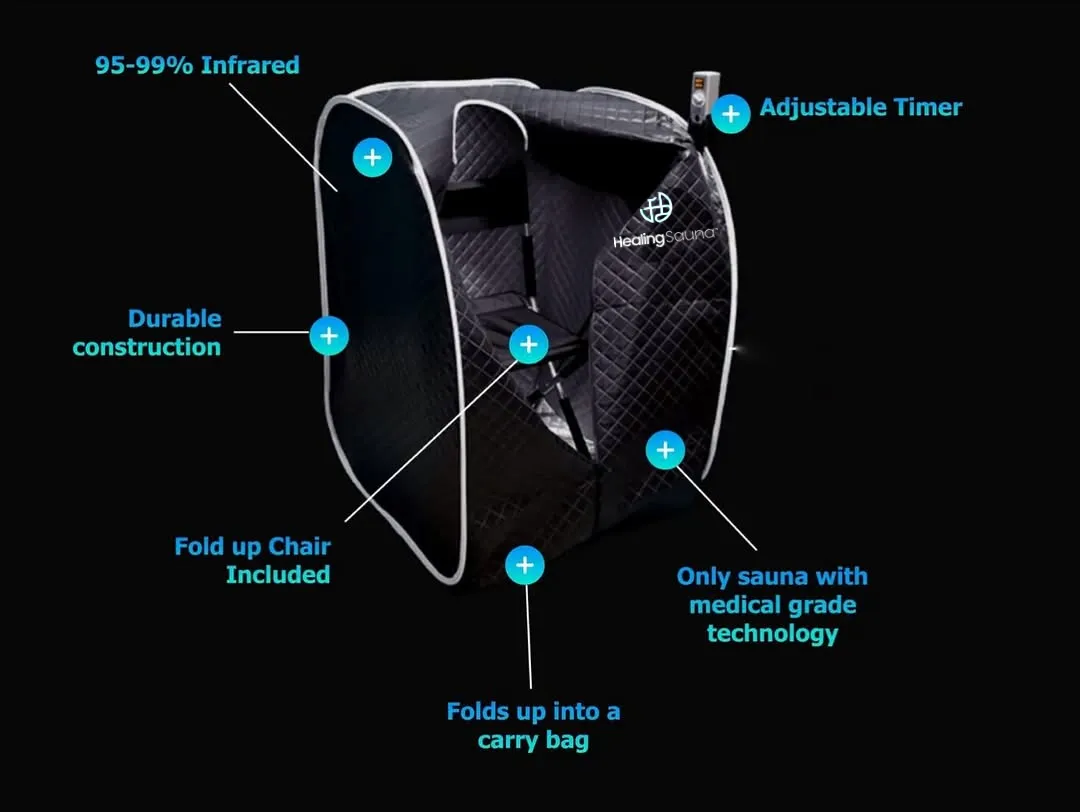
Form factor ranges from compact one-person upright units to cabin-style rooms accommodating up to five people, with the two-to-four-person cabin being the most common residential footprint. Pre-built models are designed for quick assembly and, in most cases, plug into standard household outlets, which removes the electrical upgrade requirement that often comes with traditional sauna installations. Fully custom-built units exist for buyers who need to fit a specific architectural space, but the pre-built category covers the majority of home use cases. Portable blanket-style infrared units are a separate sub-category entirely: they wrap around the body rather than enclosing it in a cabin, which changes the thermal experience and coverage significantly.
The interior layout matters more than aesthetics. This is where emitter panel layout comes in: the placement and coverage area of infrared panels within the cabin, which determines how evenly heat reaches different parts of the body during a session. Panels positioned only at the back wall create directional heat that hits some areas more than others. Units with panels on the side walls, beneath the bench, and at the back distribute exposure more uniformly, reducing hot spots and ensuring the wavelengths reach the tissue they're intended to target. Buyers focused on consistent full-body coverage should check the panel map in the product specs, not just the total wattage.
One visual feature that generates genuine buyer confusion is the red glow. Whether a sauna glows red depends entirely on which emitter type it uses, and this is the distinction between visible and non-visible infrared operation. NIR emitters produce wavelengths at the shorter end of the infrared range, close enough to visible light that they emit a noticeable red-orange glow during operation. FIR emitters work at much longer wavelengths, well outside the visible spectrum, so they produce no visible light at all. A FIR sauna running at full power looks, from the outside, like a warm wooden box with no obvious heat source. A NIR sauna glows. Full-spectrum units, which include emitters across the wavelength range, will typically have some glowing panels and some that don't.
This means the red glow is a visual indicator of emitter type, not a signal of quality or intensity. A non-glowing sauna is not malfunctioning; it's using FIR technology. A glowing sauna is not necessarily incorporating red light therapy in the clinical sense. As established when covering wavelength types, NIR output can overlap with red light therapy ranges, but dedicated LED panels for photobiomodulation are separate components and should be listed explicitly in the product specifications if that application matters to you.
Carbon heater panels, which tend toward flat, even surfaces, generally produce more uniform heat distribution across the walls where they're mounted. Ceramic heaters can concentrate heat more intensely in a smaller area, which creates variation in temperature across the cabin depending on where you're seated relative to the elements.

In practice, when you look at a product photo or walk into a showroom unit, the visible glow tells you the emitter type, the panel placement tells you about heat distribution, and the door and wood configuration tell you about build quality and cleaning practicality. None of these are cosmetic decisions. Each one reflects the engineering choices behind the technology installed in the walls.
Performance & Effectiveness Evaluation
Knowing how an infrared sauna is built and why it's built that way only gets you so far. The more pressing question is whether any of it actually works.
To answer that honestly, it helps to understand how health evidence gets evaluated, because not all research carries equal weight. This is the idea behind an evidence hierarchy in wellness research: a spectrum that runs from anecdotal reports and single case studies at one end, through observational data and small clinical trials in the middle, up to large randomized controlled trials and systematic reviews at the top. Claims backed by Tier-1 evidence, the kind that appears in peer-reviewed journals with adequate sample sizes and controls, deserve more confidence than claims drawn from a brand's white paper or a single practitioner's testimonial. Knowing where a claim sits on that spectrum is what separates a purchasing decision grounded in evidence from one built on marketing copy.

Cardiovascular benefitssit at the strongest end of the infrared-specific research base. Clinical research published in PMC supports FIR therapy for cardiovascular function, including better endothelial function in patients with cardiovascular disease, reduced blood pressure, and improved circulation. The Cleveland Clinic confirms that infrared sauna use gently raises heart rate in a way that mimics the cardiovascular effects of moderate exercise. Research in PMC has also reported associations between frequent FIR sauna use and up to a 66% lower incidence of heart disease, stroke, and dementia, though these are observational findings and the Mayo Clinic notes that infrared-specific studies tend to be small in scale, meaning larger trials are still needed before those numbers should be treated as settled.
Muscle recovery and pain reliefhave solid support from both the Cleveland Clinic and Mayo Clinic, with the Cleveland Clinic specifically identifying reduced muscle soreness, joint pain relief, and potential benefit for conditions like fibromyalgia and arthritis. PMC reviews also rate support for FIR sauna benefits in chronic pain as fair, with some data suggesting improvement sustained over two years. Relaxation is similarly well-supported, with the Cleveland Clinic citing it among the consistently documented benefits of regular use.
Detoxificationis where the evidence picture gets genuinely complicated. The Cleveland Clinic acknowledges that infrared saunas induce deep sweating and that sweat can carry substances like heavy metals. What the Cleveland Clinic also makes clear is that robust proof for the deep detoxification claims common in marketing, specifically the idea that infrared saunas systematically clear toxins from organs or fat stores, is lacking. Sweat-based excretion happens, but the liver and kidneys handle the bulk of metabolic waste removal. Claims about dramatically accelerated toxin clearance or organ-level detox lack scientific support.
Immune support, sleep improvement, and mood benefitsappear in multiple sources but are drawn from smaller studies and observational reports. Healthline describes the overall infrared evidence base as promising but frequently derived from limited data. These are reasonable hypotheses with some preliminary backing, not proven outcomes.
The genuine tradeoffs are worth naming directly. On the pro side: lower operating temperatures make sessions accessible to people who struggle with traditional high-heat environments, longer sessions at around 30 to 40 minutes are tolerable at these temperatures, home installation is feasible without major electrical work, and the research supporting cardiovascular and recovery benefits is real. On the con side: the FIR-specific evidence base is thinner than decades of traditional sauna research, unit costs are significant relative to gym access, daily users should verify EMF ratings as covered earlier, and build quality varies considerably across manufacturers.
The skepticism behind queries like "do far infrared saunas work" is understandable and, in part, earned. The technology itself is not fraudulent. The mechanisms are real, and the cardiovascular and pain-relief evidence is credible. What has earned the skepticism is a subset of brand-level claims—including specific detoxification protocols, weight loss, and organ regeneration—that lack meaningful research support. Separating the category from the individual claim is the useful move. The Cleveland Clinic's position reflects this well: infrared sauna benefits are best realized when integrated into a broader wellness routine, not treated as a standalone medical intervention.
Making Your Decision
The framework from this guide doesn't require you to become a sauna expert before buying. It requires you to answer a few specific questions about your own situation, and the answers make the decision straightforward.
Start with wavelength type,because everything else follows from it. If your primary goals are cardiovascular support, deep tissue pain relief, and relaxation, FIR is where the most credible research sits. PMC studies point to FIR's effects on endothelial function, oxidative stress reduction, and pain relief in conditions like rheumatoid arthritis and fibromyalgia. If skin health and cellular effects are your focus, NIR is the relevant band. If you want both without committing to one, a full-spectrum unit covers all three wavelength ranges in a single session, though it costs more and the incremental benefit over a well-specified FIR unit depends on how clearly you've defined your goals.

Your existing access to heat therapy changes the calculation significantly. If you already use a traditional Finnish-style sauna regularly, the case for adding an infrared unit rests on specific gaps: heat sensitivity that limits your tolerance at higher temperatures, a preference for longer sessions, or the convenience of home installation without a major electrical project. If you have no sauna access at all, infrared's lower entry cost and simpler installation make it a practical starting point for the cardiovascular and recovery benefits the Cleveland Clinic identifies.
The steam room question is a humidity preference, not a heat-delivery tradeoff. Infrared doesn't approximate steam at lower intensity. The physiological mechanisms are different, the session experience is different, and mixing them requires a hybrid unit built for the purpose. If you find dry heat uncomfortable, that's a genuine preference worth respecting, but it's separate from the question of which modality delivers better health outcomes.
On EMF,the rule is simple: ask for a milligauss measurement taken at occupant distance, and confirm whether it comes from third-party testing. As Spaworld notes, self-reported manufacturer figures lack external verification. Any claim that doesn't include a specific mG number at seated distance isn't telling you anything meaningful about your actual exposure during a session.
Design formatneeds to match your installation reality before you evaluate price. A two-person cabin has a meaningfully different footprint, electrical draw, and ventilation requirement than a one-person pod. Confirm the measurements against your available space, check whether the unit plugs into a standard outlet or requires a dedicated circuit, and verify panel coverage across the cabin interior, not just total wattage.
Weight the evidence in proportion to its strength. The cardiovascular and pain-relief research on FIR saunas has genuine support from PMC and the Cleveland Clinic, even if the studies are often small and short-term. Claims about deep detoxification, dramatic weight changes, or organ-level effects have not cleared the same bar, and the Mayo Clinic notes that the FIR-specific research base still needs larger randomized trials before its findings can be treated as settled. Prioritize outcomes with direct FIR evidence. Treat everything else as preliminary.
Finally, consider whether a full cabin sauna is the right tool for your primary goal or a significant investment on top of it. Photobiomodulation targets a cellular process that a standard infrared session doesn't replicate, and a Biomat delivers localized FIR without the systemic thermal load. If either of those outcomes is what you're actually after, a cabin sauna is an addition to that device, not a replacement. Verify explicitly in product specifications whether integrated red light panels are included, because marketing language around this is inconsistent.
The technology is real, the credible benefits are specific, and the right unit for you is the one that matches your goals to the wavelength type with the most relevant evidence, fits your space and installation constraints, and carries EMF documentation you can verify.
The word "infrared" on a product label is a starting point, not a conclusion. What wavelength the unit emits, how its heaters are built, what its EMF rating actually measures, and which of its claimed benefits have credible research behind them: those specifics are what determine whether a given sauna fits your goals or simply fits a marketing category.
The framework this guide has built gives you a way to read any product page with clear eyes. Wavelength type tells you where the evidence sits: FIR has the most established research for cardiovascular support and pain relief, with PMC studies and Cleveland Clinic guidance pointing in consistent directions, while NIR applies to skin and cellular effects and full-spectrum units cover both at a higher price point. Heater construction tells you what the heat experience will actually feel like in the cabin and gives you the first signal about EMF performance, since carbon panels tend toward more uniform output and lower field emissions than ceramic elements. EMF documentation is only meaningful when it comes with a specific milligauss reading taken at occupant distance and backed by third-party testing; anything short of that tells you nothing useful about your actual exposure during a session.
On the evidence side, the credible benefits are real and specific. The Cleveland Clinic and Mayo Clinic both acknowledge genuine support for cardiovascular effects, muscle recovery, pain relief, and relaxation. Claims about deep organ detoxification and dramatic weight changes have not cleared the same bar: the Cleveland Clinic is direct that robust proof for those marketing-level claims is lacking, and the research on toxin elimination remains, in the Cleveland Clinic's own framing, still in its infancy. Healthline describes the broader infrared evidence base as promising but frequently limited in scale, which is an honest summary. The mechanisms are legitimate, the strongest benefits are well-supported, and several other claimed effects remain preliminary. The Mayo Clinic's position is that larger randomized trials are still needed before the more ambitious findings can be treated as settled.
Safe use follows naturally from understanding the mechanism. The Mayo Clinic recommends keeping sessions to 15 to 30 minutes and staying properly hydrated before, during, and after. Healthline notes that alcohol and infrared sauna use are a poor combination. Most healthy adults can use them without issue, but the same heat-stress physiology that produces the benefits also makes basic precautions worth keeping.
Practical constraints matter as much as clinical evidence. Design format determines your real installation options: a two-person cabin has different space, electrical, and ventilation requirements than a single-person pod, and verifying those specifics against your actual room prevents expensive surprises. If photobiomodulation is a priority, a standard infrared session does not replicate that process; you need either an integrated red light panel explicitly listed in the product specifications or a separate device. Marketing language around this is inconsistent, so confirm rather than assume.
With these tools in place, the decision becomes a matching problem rather than a research project. Match your primary goals to the wavelength type with the strongest relevant evidence. Verify the design format against your installation reality. Confirm EMF claims with third-party measurements at occupant distance. Weight the benefits you're expecting against what the research actually supports. The Cleveland Clinic's framing is the right one to keep in mind: infrared sauna benefits are best realized as part of a broader wellness routine, not as a standalone intervention or a substitute for medical care.
The technology is legitimate. The credible benefits are specific. With a clear picture of mechanism, wavelength, safety specifications, and evidence quality, you have everything you need to find the unit that actually fits.